LL-37
LL-37
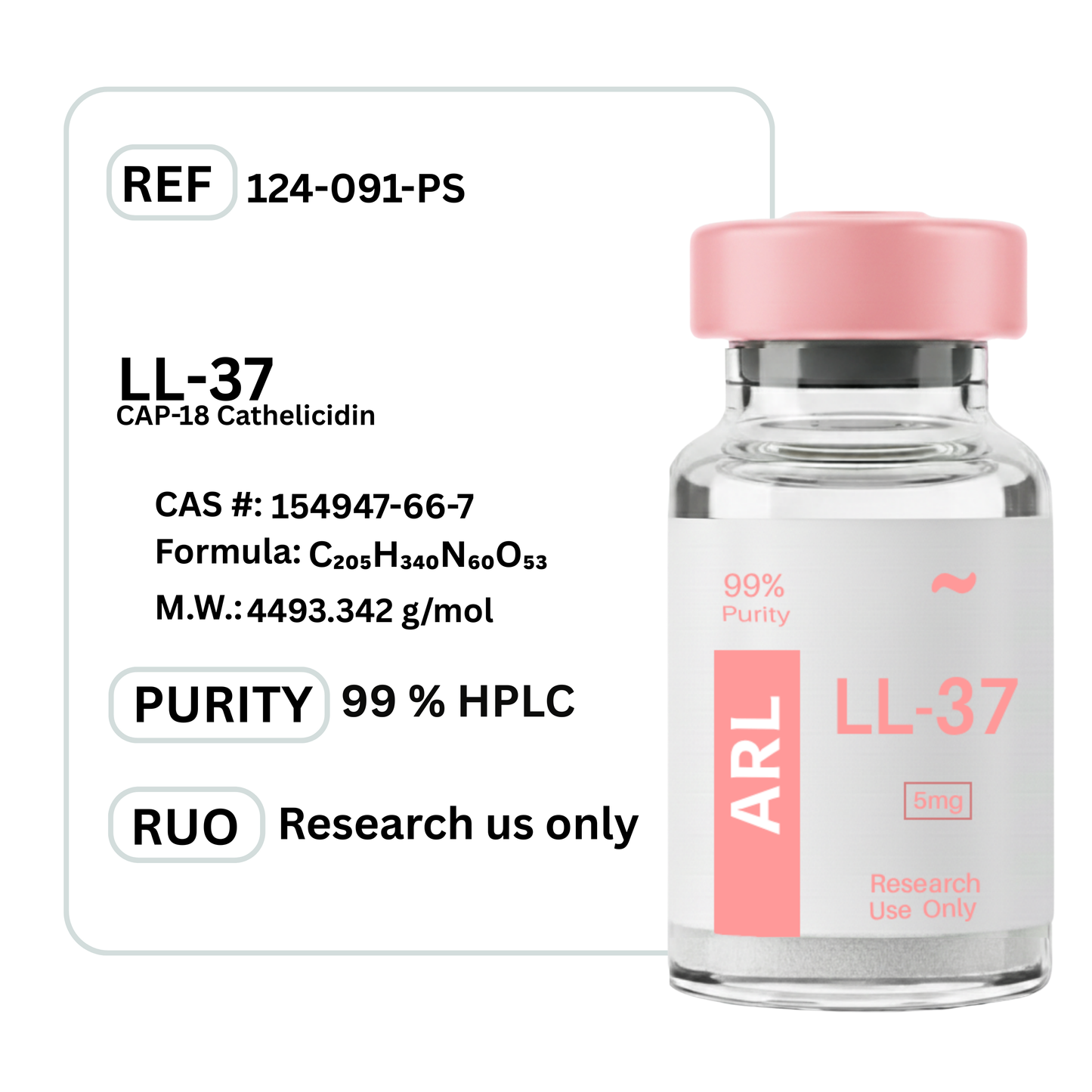
This batch of LL-37 Antimicrobial Peptide has been third party lab tested and verified for quality.
Contents: LL-37
Form: Powder
Purity: 99.3%
Couldn't load pickup availability
Free Reconstitution Solution automatically added to your cart with each order.
This product is Made, Tested & Shipped From Canada.
Ships Today
Order by 1:00 PM EST
Free Shipping
For 2 or more vials
Verified+

Antimicrobial Research Peptide (AMP): LL-37 Scientific Profile
Introduction to LL-37
LL-37 is the sole human cathelicidin-derived antimicrobial peptide (AMP), representing a crucial component of the innate immune system. Its discovery and subsequent characterization have made it a primary tool for researchers investigating the body's first line of defense against bacterial, viral, and fungal pathogens. LL-37 is derived from the C-terminal cleavage of the human cathelicidin pro-protein, hCAP-18, and is distinguished by its 37 amino acid sequence, which begins with two leucines (LL).
This document provides a scientific profile of LL-37, focusing on its mechanism of action, specific antimicrobial applications in research, and its broader role in host defense and inflammation.
1. Core Scientific Profile
Molecular Characteristics
LL-37 is classified as a cationic and amphipathic peptide. These two properties are fundamental to its function.
- Cationic Nature: At physiological pH, the peptide possesses a net positive charge due to the presence of multiple basic amino acid residues (e.g., Lysine and Arginine). This is critical for the initial electrostatic attraction to negatively charged surfaces.
- Amphipathic Structure: The molecule has distinct hydrophobic and hydrophilic faces, allowing it to interact effectively with the lipid bilayer of cell membranes. Upon binding, LL-37 adopts an alpha-helical conformation, facilitating its integration into the membrane.
Mechanism of Action
The primary, and most researched, mechanism of LL-37 is its direct antimicrobial effect through membrane disruption.
LL-37's mechanism can be summarized in the following steps:
- Binding: Due to its cationic nature, LL-37 is electrostatically attracted to the negatively charged outer leaflet of the bacterial plasma membrane (which contains anionic lipids like phosphatidylglycerol and cardiolipin).
- Insertion: The amphipathic structure allows the peptide to insert into the lipid bilayer.
- Disruption and Lysis: Several models (including the "barrel-stave," "toroidal pore," and "carpet" models) describe how LL-37 forms pores or defects in the membrane, leading to increased permeability, leakage of cellular contents, and ultimately, bacterial cell lysis and death.
This membrane-targeting mechanism provides a distinct advantage over conventional antibiotics, which often target intracellular processes, as it makes the development of resistance more difficult.
2. Research Applications and Efficacy
LL-37 is an experimental reagent and is widely used across various microbiological and immunological research assays.
2.1. Biofilm Inhibition and Degradation
Bacterial biofilms—structured communities of cells enclosed in a self-produced polymeric matrix—are a major challenge in clinical settings, as they confer high resistance to antibiotics and host immune defenses.
- Inhibition Studies: LL-37 is extensively investigated for its ability to inhibit the initial stages of biofilm formation across a range of clinically relevant pathogens, particularly Gram-negative bacteria like Pseudomonas aeruginosa.
- Degradation: Research assays demonstrate LL-37's capacity to disrupt and degrade established biofilms, potentially by penetrating the matrix and targeting the residing bacteria.
2.2. Synergy in Antimicrobial Assays
LL-37 often exhibits enhanced activity when combined with other antimicrobial agents, making it a focus for combination therapy research.
- Peptide Synergy: It has been shown to act cooperatively with other antimicrobial peptides, such as Human Beta-Defensin 2 (HBD-2), leading to a synergistic effect in clearing infections, particularly those caused by drug-resistant strains.
- Antibiotic Synergy: Research explores its capacity to potentiate the effect of traditional antibiotics, potentially by increasing bacterial membrane permeability, thus allowing the antibiotic to penetrate the cell more effectively.
2.3. Research against Drug Resistance
As antibiotic resistance grows, LL-37 serves as a crucial tool for studying novel approaches to combat multi-drug resistant (MDR) bacteria. Researchers use LL-37 to:
- Mechanism Elucidation: Identify and characterize resistance mechanisms that specific bacteria might develop against cationic peptides.
- Peptide Modification: Synthesize modified or truncated analogs of LL-37 to enhance potency, reduce toxicity to host cells, and overcome bacterial defense strategies.
3. Immunomodulatory Roles
Beyond its direct antimicrobial activity, LL-37 plays a complex and significant role in modulating the host immune response, which is a major area of current research.
- Chemotaxis: LL-37 acts as a chemoattractant, recruiting immune cells such as neutrophils, monocytes, and T-cells to sites of infection and inflammation. This is critical for coordinating the adaptive immune response.
- Wound Healing: It is associated with promoting re-epithelialization and angiogenesis, suggesting a role in tissue repair and wound closure.
- Anti-inflammatory Effects: In certain contexts, LL-37 can neutralize the toxic effects of bacterial lipopolysaccharide (LPS, endotoxin), thereby mitigating excessive or harmful inflammatory responses (sepsis research).
4. Experimental Use Guidelines
LL-37 is classified as an Experimental Reagent and should be used strictly for in vitro and in vivo research purposes, following all established laboratory safety and handling protocols.
Parameter
Recommended Application
Notes
Purity
>95% (HPLC)
Essential for reproducible results in sensitive assays.
Storage
-20°C or below
Store as lyophilized powder or in sterile, non-ionic buffers.
Solubility
Water or dilute acetic acid
Can aggregate in high salt concentrations.
Ideal Assays
Microbiology assays, Biofilm inhibition studies, Drug resistance research
Use appropriate controls for membrane permeability and cell viability.
Toxicity
Research necessary
Assess cytotoxicity on mammalian cell lines if studying in vivo potential.
5. Associated Research Resources
Researchers often utilize related protocols and documentation when working with LL-37.
- Protocol for Minimum Inhibitory Concentration (MIC) Determination: File
- Safety Data Sheet (SDS) for LL-37: File
- Recent Publications on LL-37 Biofilm Activity: [Link to academic database]
6. Future Directions in LL-37 Research
Ongoing research efforts focus on overcoming the major challenges associated with AMPs, including susceptibility to proteases, potential host cell toxicity at high concentrations, and high production costs. Future research areas include:
- Peptidomimetics: Developing small, non-peptidic molecules that mimic the structure and function of LL-37 to improve stability and bioavailability.
- Targeted Delivery: Utilizing nanoparticles or encapsulation techniques to deliver LL-37 specifically to infection sites, such as the location of an acute infection or a chronic biofilm.
- Cancer Research: Emerging evidence suggests LL-37 may possess anti-tumor properties, specifically by promoting apoptosis and modulating the tumor microenvironment, opening a new area for investigation.
For further scientific discussion or to coordinate research collaboration on LL-37, please contact Person at the Research Department before Date to set up a meeting: Calendar event.
-
check_circle
HIGHEST QUALITY PEPTIDES
Our products are scientifically formulated and manufactured in cGMP-compliant facilities.
-
encrypted
FAST DELIVERY
Enjoy fast and reliable 3–5 day shipping.
-
check_circle
Dedicated Customer Service
Our customer service team is highly knowledgeable in peptide research and its applications. We’re available 24/7 to assist you.
Verified reviews
Tested. Verified. Trusted.
We take a laboratory-first approach to quality. Each batch is made under controlled conditions and verified by an independent lab (HPLC/MS). We only ship batches that test ≥99% purity, and we provide a full COA, including identity, methods, and chromatograms, for your review.
You may also like
-
NAD+ (Nicotinamide Adenine Dinucleotide) - Research Grade Coenzyme
Regular price From $40.00Regular price From $40.00 Sale priceUnit price / per$53.0024% -
SAVE 25%Reconstitution Solution
Regular price $15.00Regular price $15.00 Sale priceUnit price / per$20.0025% -
SAVE 25%Tirzepatide
Regular price From $50.00Regular price From $50.00 Sale priceUnit price / per$67.0025% -
SAVE 24%Thymosin Alpha-1
Regular price From $79.00Regular price From $79.00 Sale priceUnit price / per$104.0024% -
SAVE 23%Tesamorelin
Regular price From $80.00Regular price From $80.00 Sale priceUnit price / per$105.0023% -
SAVE 23%Survodutide
Regular price $299.00Regular price $299.00 Sale priceUnit price / per$392.0023% -
SAVE 26%Sterile Water
Regular price From $14.00Regular price From $14.00 Sale priceUnit price / per$19.0026% -
SAVE 24%SS-31 - Premium Research Peptide
Regular price From $100.00Regular price From $100.00 Sale priceUnit price / per$132.0024% -
SAVE 23%SLU-PP-332
Regular price $125.00Regular price $125.00 Sale priceUnit price / per$164.0023% -
SAVE 23%Sermorelin
Regular price From $70.00Regular price From $70.00 Sale priceUnit price / per$92.0023% -
SAVE 23%Semaglutide
Regular price From $36.00Regular price From $36.00 Sale priceUnit price / per$47.0023% -
SAVE 23%Retatrutide Triple Agonist
Regular price From $90.00Regular price From $90.00 Sale priceUnit price / per$118.0023% -
SAVE 26%Oxytocin Acetate
Regular price $42.00Regular price $42.00 Sale priceUnit price / per$57.0026% -
SAVE 24%NAD+ - Premium Research Peptide
Regular price From $40.00Regular price From $40.00 Sale priceUnit price / per$53.0024% -
SAVE 25%MOTS-c - Premium Research Peptide
Regular price From $50.00Regular price From $50.00 Sale priceUnit price / per$67.0025% -
SAVE 25%Melanotan II (MT2)
Regular price $50.00Regular price $50.00 Sale priceUnit price / per$67.0025% -
SAVE 24%Lipo-C with B Vitamins
Regular price $85.00Regular price $85.00 Sale priceUnit price / per$112.0024% -
SAVE 23%Lemon Bottle
Regular price $80.00Regular price $80.00 Sale priceUnit price / per$105.0023% -
SAVE 23%L-Carnitine
Regular price $97.00Regular price $97.00 Sale priceUnit price / per$127.0023% -
SAVE 24%KPV Tripeptide
Regular price From $56.00Regular price From $56.00 Sale priceUnit price / per$74.0024% -
KLOW Blend - GHK-CU + TB-500 + BPC-157 + KPV 10mg
Regular price $200.00Regular price $200.00 Sale priceUnit price / per$261.0023% -
SAVE 23%Kisspeptin-10
Regular price From $65.00Regular price From $65.00 Sale priceUnit price / per$85.0023% -
SAVE 23%Ipamorelin
Regular price From $32.00Regular price From $32.00 Sale priceUnit price / per$42.0023% -
SAVE 24%IGF-1 LR3 (Long R3)
Regular price From $40.00Regular price From $40.00 Sale priceUnit price / per$53.0024% -
SAVE 24%Hyaluronic
Regular price $28.00Regular price $28.00 Sale priceUnit price / per$37.0024% -
SAVE 23%HGH Fragment 176-191
Regular price $97.00Regular price $97.00 Sale priceUnit price / per$127.0023% -
SAVE 23%HGH 191AA (Somatropin)
Regular price From $55.00Regular price From $55.00 Sale priceUnit price / per$72.0023% -
SAVE 25%Gonadorelin
Regular price $50.00Regular price $50.00 Sale priceUnit price / per$67.0025% -
Glutathione - Premium Research Peptide
Regular price $83.00Regular price $83.00 Sale priceUnit price / per$109.0023% -
SAVE 23%Glow BPC-157 + GHK-CU + TB-500
Regular price $139.00Regular price $139.00 Sale priceUnit price / per$181.0023%
Every vial we sell comes from a lab that follows current Good Manufacturing Practices (cGMP). That means each step of production is documented and controlled. Before a batch is released, it’s tested by independent third-party labs for purity, identity, and sterility. Certificates of analysis are available so you can see the exact test results.
Yes. The labs we work with use ISO-certified clean rooms where air quality, equipment, and handling procedures are tightly regulated. Staff are trained to pharmaceutical-grade standards. This ensures the peptides are produced in an environment that minimizes contamination risks.
Peptides in lyophilized (freeze-dried) form are stable at room temperature for transport. Once you receive them, refrigeration is recommended to maintain long-term integrity. We package every order securely to prevent damage and ship promptly, so your vials arrive in optimal condition.
We operate under strict in-house protocols that follow current Good Manufacturing Practices (cGMP). That means our team oversees the entire process from sourcing raw amino acids to the final lyophilized vial. Nothing is outsourced or repackaged. This gives us full control over purity, consistency, and sterility, and it’s why we can stand behind every single vial we ship.
Store them in the refrigerator, away from direct light and heat. If you need to keep them longer, some peptides can be stored frozen. Each vial comes with clear handling instructions so you know the proper conditions for stability.
The strongest proof is transparency. For every peptide, we can provide certificates of analysis, manufacturing documentation, and references to the published scientific research behind it. If you ever have questions, we’ll show you the data rather than ask you to take our word for it.
The difference is transparency. Most sites give you a product name and a price. We provide full batch testing, lab documentation, and direct access to certificates of analysis so you don’t have to guess what you’re getting. When you order from us, you know exactly what’s in the vial, where it was made, and how it was verified.