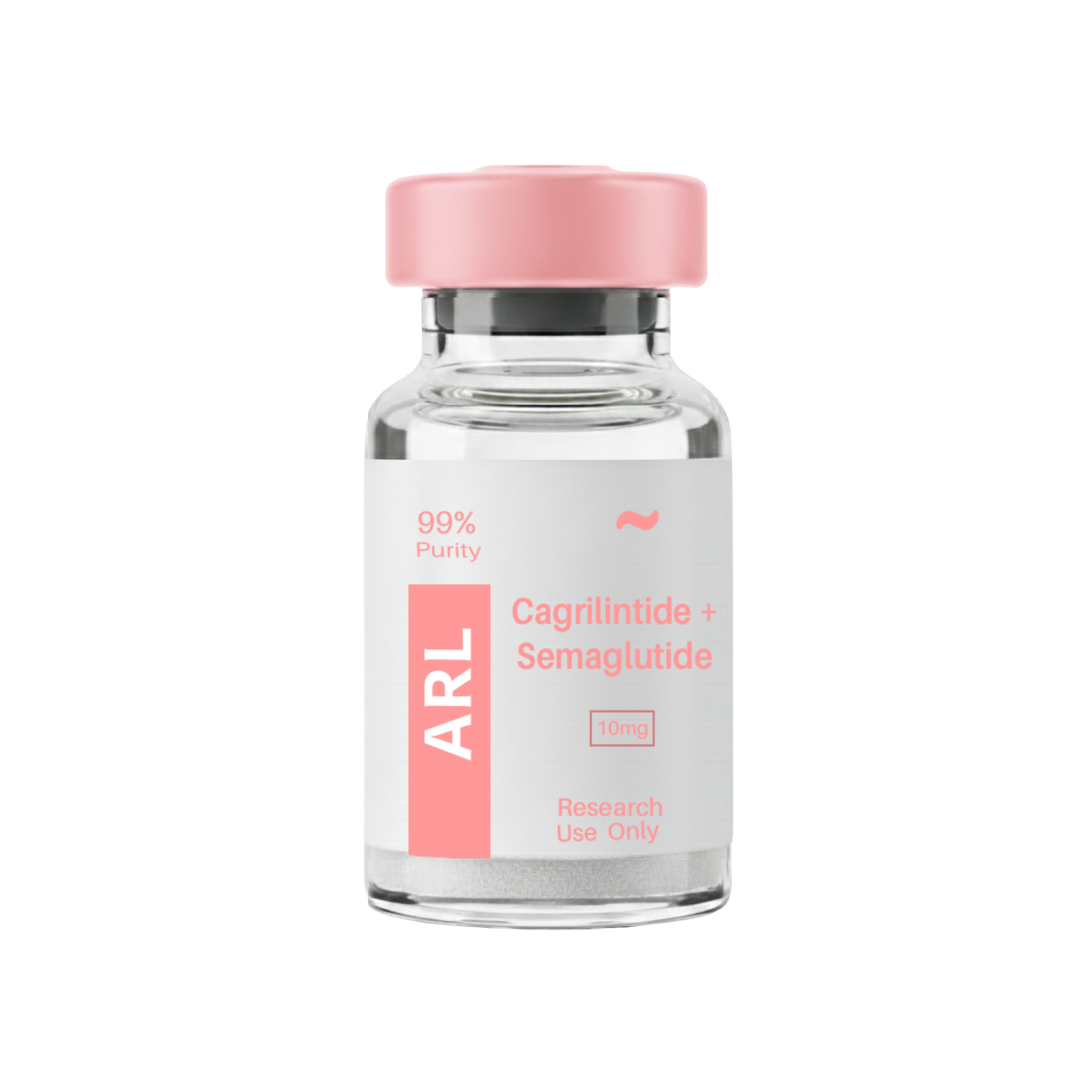
Cagrilintide + Semaglutide
This batch of Cagrilintide + Semaglutide Peptide Blend has been third party lab tested and verified for quality.
Contents: Cagrilintide (Amylin Analogue) + Semaglutide (GLP-1 Receptor Agonist) Combination
Form: Powder
Purity: 99.3%
Couldn't load pickup availability
Free Reconstitution Solution automatically added to your cart with each order.
This product is Made, Tested & Shipped From Canada.
Ships Today
Order by 1:00 PM EST
Free Shipping
For 2 or more vials
Verified+

1. Product and Research Context
The Metabolic Function Research Blend is a specialized formulation designed for advanced research in metabolic disorders. Its primary purpose is to enable the accurate monitoring and assessment of specific biomarkers associated with hepatic (liver) and lipid metabolism.
Key Research Objectives and Targets
The blend's usage is predicated on observing and quantifying changes across three critical areas of metabolic health:
- Hepatic Metabolic Function: Assessing changes in liver function and markers related to fatty acid metabolism. This includes monitoring enzyme activities and gene expression profiles indicative of hepatocellular health and fat processing.
- Lipid Profile: Tracking systemic changes in circulating lipids, primarily focusing on the reduction of triglycerides and the overall impact on fat burden, especially in the abdominal region.
- Visceral Adiposity: A specific and critical target is the reduction of dangerous visceral fat depots (VFD). This type of fat is strongly linked to insulin resistance, cardiovascular disease, and chronic inflammation.
2. Usage and Target Models
The Metabolic Function Research Blend is strictly intended for in vitro and animal model experimentation.
In Vitro Applications
The blend is suitable for testing on various cell lines relevant to metabolic research:
Cell Line/Model
Purpose
Expected Outcome Monitoring
HepG2/Other Hepatocyte Lines
Fatty Liver Model: Loading with high free fatty acids to induce steatosis.
Lipid accumulation (oil red O staining), gene expression (SREBP-1c, FAS), enzyme activity.
Adipocytes (3T3-L1)
Adipogenesis/Lipolysis: Testing the blend's effect on fat cell development and breakdown.
Differentiation markers (PPAR-gamma), lipolysis rate (glycerol release).
Macrophages (e.g., RAW 264.7)
Inflammation Model: Co-culture with hepatocytes to assess inflammatory response.
Cytokine release (TNF-alpha, IL-6), NF-kB signaling.
Animal Model Applications
The blend is specifically designed for use in established models of metabolic disease:
- Non-Alcoholic Fatty Liver Disease (NAFLD) / Non-Alcoholic Steatohepatitis (NASH) Models:
- Diet-Induced: High-fat, high-sucrose, or Western diets in rodents (e.g., C57BL/6J mice).
- Genetic: Models like the ob/ob or db/db mouse for concurrent diabetes and obesity.
- Dyslipidemia Models: Hypercholesterolemic or hypertriglyceridemic rodent models.
3. Recommended Research Protocol Steps
The following outlines a general, non-specific protocol for studies utilizing the Metabolic Function Research Blend. Specific dosages and administration routes must be determined by the lead researcher based on the model.
3.1. Study Design
Component
Description
Placeholder Example
Model Selection
Appropriate animal or in vitro model (e.g., C57BL/6J fed Western Diet).
[Animal model specifics]
Grouping
Vehicle Control, Positive Control (Established drug), Research Blend Low Dose, Research Blend High Dose.
4-5 groups, n=10 animals per group.
Duration
The study duration should allow sufficient time for metabolic shifts (e.g., 4-12 weeks).
Date to Date
3.2. Administration
The preferred administration route for animal models is oral gavage or dietary inclusion.
Route
Example Dose Volume/Concentration
Frequency
Oral Gavage
100-200 µL/day, 10-50 mg/kg BW
Once daily
Dietary Inclusion
0.1-0.5% (w/w) in chow
Ad libitum
4. Primary Biomarker Endpoints
The success of the research is measured by the change in specific biomarkers. These are divided into core categories:
4.1. Hepatic Metabolism Biomarkers (Tissue and Plasma)
- Liver Enzymes: Alanine Aminotransferase (ALT), Aspartate Aminotransferase (AST).
- Fatty Acid Metabolism:
- mRNA Expression: SREBP-1c, Fatty Acid Synthase (FAS), Carnitine Palmitoyltransferase 1 (CPT1), Peroxisome Proliferator-Activated Receptor Alpha ($\text{PPAR}\alpha$).
- Histology: H&E staining (steatosis scoring), Picrosirius Red (fibrosis).
- Antioxidant Status: Superoxide Dismutase (SOD), Glutathione (GSH).
4.2. Lipid Profile Biomarkers (Plasma)
- Primary Targets: Triglycerides (TG), Total Cholesterol (TC), Low-Density Lipoprotein Cholesterol (LDL-C), High-Density Lipoprotein Cholesterol (HDL-C).
- Apolipoproteins: ApoB, ApoA-I.
4.3. Adiposity and Visceral Fat Biomarkers (In Vivo Imaging/Post-Mortem Analysis)
Visceral adiposity reduction is the most challenging and specific outcome to monitor.
- Body Composition Analysis: Dual-energy X-ray Absorptiometry (DXA) or Nuclear Magnetic Resonance (NMR) to determine total fat mass and lean mass weekly.
- Visceral Fat Measurement:
- In Vivo: Magnetic Resonance Imaging (MRI) or Computed Tomography (CT) scans to specifically quantify VFD at baseline, mid-point, and endpoint.
- Post-Mortem: Precise dissection and weighing of key fat depots (e.g., epididymal, perirenal, mesenteric fat pads) at sacrifice.
5. Secondary Outcome Measures
These measures provide context and support the primary metabolic findings.
Category
Measure/Test
Purpose
Glucose Homeostasis
Fasting Glucose, Insulin, HOMA-IR, Glucose Tolerance Test (GTT)
Assess insulin sensitivity and glucose regulation.
Inflammation
Plasma Cytokines (TNF-$\alpha$, IL-6, $\text{MCP}-1$), Tissue Macrophage Markers (F4/80)
Determine anti-inflammatory or pro-inflammatory effects.
Safety
Body Weight, Food/Water Intake, General Activity Levels
Monitor overall animal health and treatment tolerability.
6. Data Analysis and Reporting
6.1. Statistical Methods
All data should be presented as mean $\pm$ Standard Error of the Mean (SEM) or Standard Deviation (SD). Statistical significance should be determined using appropriate tests:
- One-way ANOVA (followed by post-hoc tests like Tukey's or Dunnett's) for comparing multiple groups at a single time point.
- Two-way ANOVA for data collected across multiple time points (e.g., GTT, body weight).
- P-value threshold for significance should be set at $p < 0.05$.
6.2. Documentation and Record Keeping
Accurate and detailed records are paramount for reproducibility. All animal husbandry details, administration logs, and assay validation reports must be maintained in the study binder, titled File.
A final summary meeting for the research findings should be scheduled with the research team via Calendar event.
7. Important Considerations
Compound Stability and Storage
The Metabolic Function Research Blend must be stored at the specified temperature (typically $-20^\circ \text{C}$) to maintain component integrity. Solutions for daily administration should be prepared fresh or stored according to manufacturer guidelines provided in the supplementary material File.
Location of Research
All animal procedures and primary assays are to be conducted at the facility located at Place.
Contact Information
For technical support or inquiries regarding the blend's components, please contact Dr. Person.
-
check_circle
HIGHEST QUALITY PEPTIDES
Our products are scientifically formulated and manufactured in cGMP-compliant facilities.
-
encrypted
FAST DELIVERY
Enjoy fast and reliable 3–5 day shipping.
-
check_circle
Dedicated Customer Service
Our customer service team is highly knowledgeable in peptide research and its applications. We’re available 24/7 to assist you.
Verified reviews
Tested. Verified. Trusted.
We take a laboratory-first approach to quality. Each batch is made under controlled conditions and verified by an independent lab (HPLC/MS). We only ship batches that test ≥99% purity, and we provide a full COA, including identity, methods, and chromatograms, for your review.
You may also like
-
NAD+ (Nicotinamide Adenine Dinucleotide) - Research Grade Coenzyme
Regular price From $40.00Regular price From $40.00 Sale priceUnit price / per$53.0024% -
SAVE 25%Reconstitution Solution
Regular price $15.00Regular price $15.00 Sale priceUnit price / per$20.0025% -
SAVE 25%Tirzepatide
Regular price From $50.00Regular price From $50.00 Sale priceUnit price / per$67.0025% -
SAVE 24%Thymosin Alpha-1
Regular price From $79.00Regular price From $79.00 Sale priceUnit price / per$104.0024% -
SAVE 23%Tesamorelin
Regular price From $80.00Regular price From $80.00 Sale priceUnit price / per$105.0023% -
SAVE 23%Survodutide
Regular price $299.00Regular price $299.00 Sale priceUnit price / per$392.0023% -
SAVE 26%Sterile Water
Regular price From $14.00Regular price From $14.00 Sale priceUnit price / per$19.0026% -
SAVE 24%SS-31 - Premium Research Peptide
Regular price From $100.00Regular price From $100.00 Sale priceUnit price / per$132.0024% -
SAVE 23%SLU-PP-332
Regular price $125.00Regular price $125.00 Sale priceUnit price / per$164.0023% -
SAVE 23%Sermorelin
Regular price From $70.00Regular price From $70.00 Sale priceUnit price / per$92.0023% -
SAVE 23%Semaglutide
Regular price From $36.00Regular price From $36.00 Sale priceUnit price / per$47.0023% -
SAVE 23%Retatrutide Triple Agonist
Regular price From $90.00Regular price From $90.00 Sale priceUnit price / per$118.0023% -
SAVE 26%Oxytocin Acetate
Regular price $42.00Regular price $42.00 Sale priceUnit price / per$57.0026% -
SAVE 24%NAD+ - Premium Research Peptide
Regular price From $40.00Regular price From $40.00 Sale priceUnit price / per$53.0024% -
SAVE 25%MOTS-c - Premium Research Peptide
Regular price From $50.00Regular price From $50.00 Sale priceUnit price / per$67.0025% -
SAVE 25%Melanotan II (MT2)
Regular price $50.00Regular price $50.00 Sale priceUnit price / per$67.0025% -
SAVE 24%Lipo-C with B Vitamins
Regular price $85.00Regular price $85.00 Sale priceUnit price / per$112.0024% -
SAVE 23%Lemon Bottle
Regular price $80.00Regular price $80.00 Sale priceUnit price / per$105.0023% -
SAVE 23%L-Carnitine
Regular price $97.00Regular price $97.00 Sale priceUnit price / per$127.0023% -
SAVE 24%KPV Tripeptide
Regular price From $56.00Regular price From $56.00 Sale priceUnit price / per$74.0024% -
KLOW Blend - GHK-CU + TB-500 + BPC-157 + KPV 10mg
Regular price $200.00Regular price $200.00 Sale priceUnit price / per$261.0023% -
SAVE 23%Kisspeptin-10
Regular price From $65.00Regular price From $65.00 Sale priceUnit price / per$85.0023% -
SAVE 23%Ipamorelin
Regular price From $32.00Regular price From $32.00 Sale priceUnit price / per$42.0023% -
SAVE 24%IGF-1 LR3 (Long R3)
Regular price From $40.00Regular price From $40.00 Sale priceUnit price / per$53.0024% -
SAVE 24%Hyaluronic
Regular price $28.00Regular price $28.00 Sale priceUnit price / per$37.0024% -
SAVE 23%HGH Fragment 176-191
Regular price $97.00Regular price $97.00 Sale priceUnit price / per$127.0023% -
SAVE 23%HGH 191AA (Somatropin)
Regular price From $55.00Regular price From $55.00 Sale priceUnit price / per$72.0023% -
SAVE 25%Gonadorelin
Regular price $50.00Regular price $50.00 Sale priceUnit price / per$67.0025% -
Glutathione - Premium Research Peptide
Regular price $83.00Regular price $83.00 Sale priceUnit price / per$109.0023% -
SAVE 23%Glow BPC-157 + GHK-CU + TB-500
Regular price $139.00Regular price $139.00 Sale priceUnit price / per$181.0023%
Every vial we sell comes from a lab that follows current Good Manufacturing Practices (cGMP). That means each step of production is documented and controlled. Before a batch is released, it’s tested by independent third-party labs for purity, identity, and sterility. Certificates of analysis are available so you can see the exact test results.
Yes. The labs we work with use ISO-certified clean rooms where air quality, equipment, and handling procedures are tightly regulated. Staff are trained to pharmaceutical-grade standards. This ensures the peptides are produced in an environment that minimizes contamination risks.
Peptides in lyophilized (freeze-dried) form are stable at room temperature for transport. Once you receive them, refrigeration is recommended to maintain long-term integrity. We package every order securely to prevent damage and ship promptly, so your vials arrive in optimal condition.
We operate under strict in-house protocols that follow current Good Manufacturing Practices (cGMP). That means our team oversees the entire process from sourcing raw amino acids to the final lyophilized vial. Nothing is outsourced or repackaged. This gives us full control over purity, consistency, and sterility, and it’s why we can stand behind every single vial we ship.
Store them in the refrigerator, away from direct light and heat. If you need to keep them longer, some peptides can be stored frozen. Each vial comes with clear handling instructions so you know the proper conditions for stability.
The strongest proof is transparency. For every peptide, we can provide certificates of analysis, manufacturing documentation, and references to the published scientific research behind it. If you ever have questions, we’ll show you the data rather than ask you to take our word for it.
The difference is transparency. Most sites give you a product name and a price. We provide full batch testing, lab documentation, and direct access to certificates of analysis so you don’t have to guess what you’re getting. When you order from us, you know exactly what’s in the vial, where it was made, and how it was verified.